
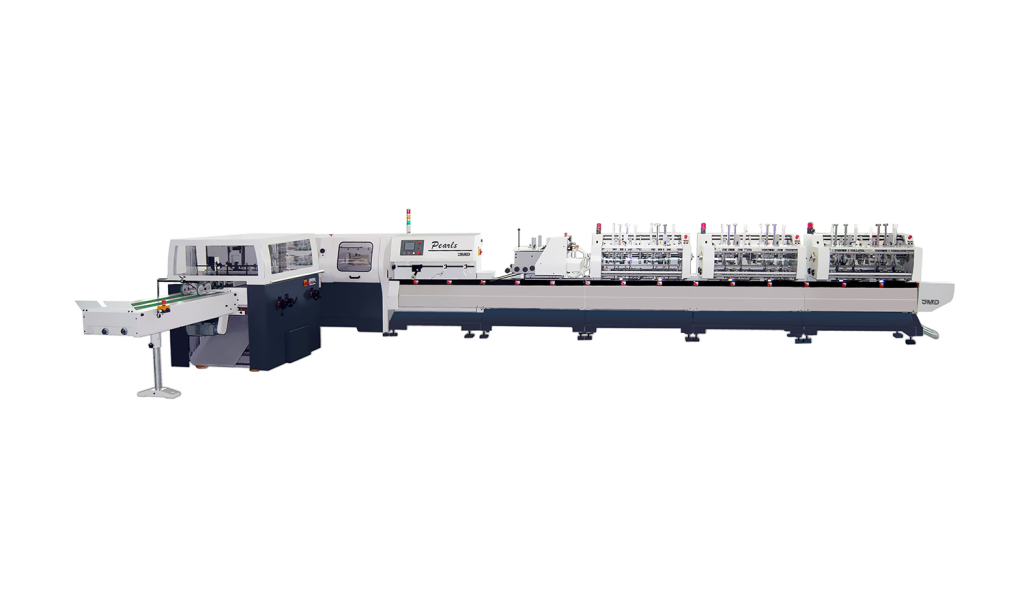
Pearls-8000 suits printers evaluating a compact saddle stitching system for commercial booklet work. Rose-12000 suits medium- and large-volume production requiring a higher mechanical speed or larger maximum book formats. Choose between them by checking your actual publication sizes, paper stocks, run lengths, job changes and production targets.
Both systems combine signature feeding, cover folding and feeding, stitching and three-knife trimming. This guide compares JMD’s published specifications and explains what to check before selecting a configuration.
Pearls-8000 vs Rose-12000: specifications at a glance
| Published specification | Pearls-8000 | Rose-12000 |
|---|---|---|
| Maximum mechanical speed | 8,000 cycles/hour | 12,000 cycles/hour |
| Maximum untrimmed book size | 365 × 305 mm | 470 × 310 mm |
| Minimum untrimmed book size | 110 × 85 mm | 138 × 105 mm |
| Maximum trimmed book size | 360 × 300 mm | 465 × 300 mm |
| Minimum trimmed book size | 105 × 65 mm | 130 × 80 mm |
| Maximum finished-product stitching thickness | 10 mm | 10 mm |
| Published machine dimensions (L × W × H) | 8,300 × 4,500 × 1,400 mm | 11,700 × 5,900 × 1,450 mm |
Dimensions follow the order used in each product specification. Minimum and maximum values do not establish every possible size combination. Confirm the complete publication format with JMD. Machine dimensions describe the equipment itself; allow additional space for feeding, delivery, access and maintenance.
Maximum mechanical speed is a machine rating, rather than a guaranteed finished-book output. Actual output depends on publication format, paper, signature quality, feeding, setup and operating conditions.
When to consider Pearls-8000
Start with Pearls-8000 when its format range and rated speed fit your commercial booklets, brochures, magazines or catalogues. Its published design combines a compact layout, central touchscreen control and a twin-feeder arrangement. Check your particular publication and stock against the proposed machine configuration.
Pearls-8000 has smaller published machine dimensions than Rose-12000 and supports smaller minimum trimmed formats. These can be useful selection factors when reviewing floor space and a mix of smaller publications. Confirm working clearances and material handling before committing to an installation layout.
When to consider Rose-12000
Consider Rose-12000 for medium- and large-volume saddle-stitched production when your workload calls for its higher rated mechanical speed or larger maximum formats. Its maximum trimmed format is 465 × 300 mm, compared with 360 × 300 mm for Pearls-8000.
For an operating example, see Guangdong Xinhua’s Rose-12000 installation for peak textbook production. That customer report describes production above 11,000 books per hour. This is a reported result from a specific installation and does not establish the output for other jobs or configurations.

Compare job changes and quality control
Count the different jobs you run each shift, rather than comparing speed alone. Review the time and work involved in changing feeder settings, publication formats, stitching and trimming. The published descriptions for both models specify handwheel adjustment with position indicators for the three-knife trimmer; touchscreen control should not be interpreted as fully automatic adjustment of every station.
Pearls-8000 lists thickness inspection and missing-stitch detection, with image recognition available as an option to detect incorrect signatures. Rose-12000 describes a quality control system for feeding and stitching faults. Ask JMD to identify the standard and optional detection functions in the configuration proposed for your publications.
How to choose using your actual work
First check whether saddle stitching suits the finished publication. Then compare the untrimmed and trimmed sizes, finished thickness, paper stocks and signature arrangement. A page count on its own is insufficient because different stocks produce different thicknesses and handling conditions.
Next, assess your typical run lengths, number of job changes, peak-season workload and required finished-book output. Compare feeding, stitching, trimming, delivery and staffing as a complete workflow. Request a quotation based on the same samples and production brief for both models, so the proposed configurations can be compared consistently.
Frequently asked questions
What is the main difference between Pearls-8000 and Rose-12000?
Pearls-8000 is a compact saddle stitching system rated at up to 8,000 cycles per hour. Rose-12000 is rated at up to 12,000 cycles per hour and has larger maximum publication formats. Compare your full format range and workload before selecting either model.
Does Rose-12000 support every size handled by Pearls-8000?
No. Rose-12000 has larger maximum formats, but Pearls-8000 supports smaller minimum formats. The published minimum trimmed size is 105 × 65 mm for Pearls-8000 and 130 × 80 mm for Rose-12000. Confirm the exact size combination for your publication.
Will the higher-speed model always finish my jobs sooner?
A higher maximum mechanical speed alone does not determine total job completion time. Setup, run length, paper handling, feeding and the rest of the production workflow affect output. Compare both models against your actual job mix.
Can a maximum page count be given for each system?
A single page-count limit would not account for differences in paper thickness and publication construction. Both current specification tables list a maximum finished-product stitching thickness of 10 mm. Send the stock specifications, signature plan and a finished sample so JMD can assess the application.
What information should I send for a recommendation?
Send the publication type, untrimmed and trimmed dimensions, finished thickness, paper types and weights, signature count, cover requirements, typical run lengths, job changes per shift, required output and available floor space. Include samples and any existing equipment to be connected.
Discuss your saddle stitching requirements
Review the full specifications for Pearls-8000 and Rose-12000, or explore print finishing solutions by application. Contact JMD for a configuration recommendation based on your publications and production targets.